> ## Documentation Index
> Fetch the complete documentation index at: https://langchain-5e9cc07a-preview-rbacpe-1762465003-c2183e4.mintlify.site/llms.txt
> Use this file to discover all available pages before exploring further.
# Middleware
> Control and customize agent execution at every step
Middleware provides a way to more tightly control what happens inside the agent.
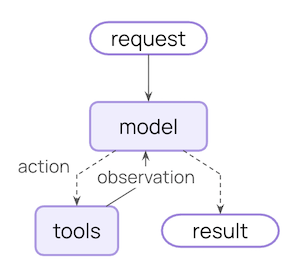
The core agent loop involves calling a model, letting it choose tools to execute, and then finishing when it calls no more tools:
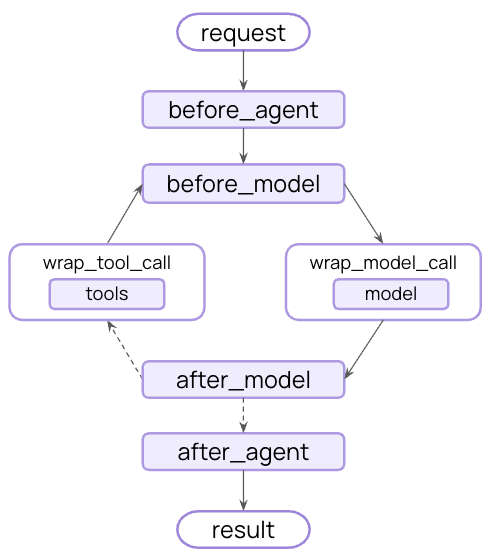
Middleware exposes hooks before and after each of those steps:
## What can middleware do?
Track agent behavior with logging, analytics, and debugging
Transform prompts, tool selection, and output formatting
Add retries, fallbacks, and early termination logic
Apply rate limits, guardrails, and PII detection
Add middleware by passing it to [`create_agent`](https://reference.langchain.com/python/langchain/agents/#langchain.agents.create_agent):
```python theme={null}
from langchain.agents import create_agent
from langchain.agents.middleware import SummarizationMiddleware, HumanInTheLoopMiddleware
agent = create_agent(
model="gpt-4o",
tools=[...],
middleware=[SummarizationMiddleware(), HumanInTheLoopMiddleware()],
)
```
## Built-in middleware
LangChain provides prebuilt middleware for common use cases:
### Summarization
Automatically summarize conversation history when approaching token limits.
**Perfect for:**
* Long-running conversations that exceed context windows
* Multi-turn dialogues with extensive history
* Applications where preserving full conversation context matters
```python theme={null}
from langchain.agents import create_agent
from langchain.agents.middleware import SummarizationMiddleware
agent = create_agent(
model="gpt-4o",
tools=[weather_tool, calculator_tool],
middleware=[
SummarizationMiddleware(
model="gpt-4o-mini",
max_tokens_before_summary=4000, # Trigger summarization at 4000 tokens
messages_to_keep=20, # Keep last 20 messages after summary
summary_prompt="Custom prompt for summarization...", # Optional
),
],
)
```
Model for generating summaries
Token threshold for triggering summarization
Recent messages to preserve
Custom token counting function. Defaults to character-based counting.
Custom prompt template. Uses built-in template if not specified.
Prefix for summary messages
### Human-in-the-loop
Pause agent execution for human approval, editing, or rejection of tool calls before they execute.
**Perfect for:**
* High-stakes operations requiring human approval (database writes, financial transactions)
* Compliance workflows where human oversight is mandatory
* Long running conversations where human feedback is used to guide the agent
```python theme={null}
from langchain.agents import create_agent
from langchain.agents.middleware import HumanInTheLoopMiddleware
from langgraph.checkpoint.memory import InMemorySaver
agent = create_agent(
model="gpt-4o",
tools=[read_email_tool, send_email_tool],
checkpointer=InMemorySaver(),
middleware=[
HumanInTheLoopMiddleware(
interrupt_on={
# Require approval, editing, or rejection for sending emails
"send_email_tool": {
"allowed_decisions": ["approve", "edit", "reject"],
},
# Auto-approve reading emails
"read_email_tool": False,
}
),
],
)
```
Mapping of tool names to approval configs. Values can be `True` (interrupt with default config), `False` (auto-approve), or an `InterruptOnConfig` object.
Prefix for action request descriptions
**`InterruptOnConfig` options:**
List of allowed decisions: `"approve"`, `"edit"`, or `"reject"`
Static string or callable function for custom description
**Important:** Human-in-the-loop middleware requires a [checkpointer](/oss/python/langgraph/persistence#checkpoints) to maintain state across interruptions.
See the [human-in-the-loop documentation](/oss/python/langchain/human-in-the-loop) for complete examples and integration patterns.
### Anthropic prompt caching
Reduce costs by caching repetitive prompt prefixes with Anthropic models.
**Perfect for:**
* Applications with long, repeated system prompts
* Agents that reuse the same context across invocations
* Reducing API costs for high-volume deployments
Learn more about [Anthropic Prompt Caching](https://docs.claude.com/en/docs/build-with-claude/prompt-caching#cache-limitations) strategies and limitations.
```python theme={null}
from langchain_anthropic import ChatAnthropic
from langchain_anthropic.middleware import AnthropicPromptCachingMiddleware
from langchain.agents import create_agent
LONG_PROMPT = """
Please be a helpful assistant.
"""
agent = create_agent(
model=ChatAnthropic(model="claude-sonnet-4-5-20250929"),
system_prompt=LONG_PROMPT,
middleware=[AnthropicPromptCachingMiddleware(ttl="5m")],
)
# cache store
agent.invoke({"messages": [HumanMessage("Hi, my name is Bob")]})
# cache hit, system prompt is cached
agent.invoke({"messages": [HumanMessage("What's my name?")]})
```
Cache type. Only `"ephemeral"` is currently supported.
Time to live for cached content. Valid values: `"5m"` or `"1h"`
Minimum number of messages before caching starts
Behavior when using non-Anthropic models. Options: `"ignore"`, `"warn"`, or `"raise"`
### Model call limit
Limit the number of model calls to prevent infinite loops or excessive costs.
**Perfect for:**
* Preventing runaway agents from making too many API calls
* Enforcing cost controls on production deployments
* Testing agent behavior within specific call budgets
```python theme={null}
from langchain.agents import create_agent
from langchain.agents.middleware import ModelCallLimitMiddleware
agent = create_agent(
model="gpt-4o",
tools=[...],
middleware=[
ModelCallLimitMiddleware(
thread_limit=10, # Max 10 calls per thread (across runs)
run_limit=5, # Max 5 calls per run (single invocation)
exit_behavior="end", # Or "error" to raise exception
),
],
)
```
Maximum model calls across all runs in a thread. Defaults to no limit.
Maximum model calls per single invocation. Defaults to no limit.
Behavior when limit is reached. Options: `"end"` (graceful termination) or `"error"` (raise exception)
### Tool call limit
Control agent execution by limiting the number of tool calls, either globally across all tools or for specific tools.
**Perfect for:**
* Preventing excessive calls to expensive external APIs
* Limiting web searches or database queries
* Enforcing rate limits on specific tool usage
* Protecting against runaway agent loops
To limit tool calls globally across all tools or for specific tools, set `tool_name`. For each limit, specify one or both of:
* **Thread limit** (`thread_limit`) - Max calls across all runs in a conversation. Persists across invocations. Requires a checkpointer.
* **Run limit** (`run_limit`) - Max calls per single invocation. Resets each turn.
**Exit behaviors:**
| Behavior | Effect | Best For |
| -------------------------- | ---------------------------------------------------------- | ------------------------------------------------------------------- |
| **`"continue"`** (default) | Blocks exceeded calls with error messages, agent continues | Most use cases - agent handles limits gracefully |
| **`"error"`** | Raises exception immediately | Complex workflows where you want to handle the limit error manually |
| **`"end"`** | Stops with ToolMessage + AI message | Single-tool scenarios (errors if other tools pending) |
```python theme={null}
from langchain.agents import create_agent
from langchain.agents.middleware import ToolCallLimitMiddleware
# Global limit: max 20 calls per thread, 10 per run
global_limiter = ToolCallLimitMiddleware(
thread_limit=20,
run_limit=10,
)
# Tool-specific limit with default "continue" behavior
search_limiter = ToolCallLimitMiddleware(
tool_name="search",
thread_limit=5,
run_limit=3,
)
# Thread limit only (no per-run limit)
database_limiter = ToolCallLimitMiddleware(
tool_name="query_database",
thread_limit=10,
)
# Strict enforcement with "error" behavior
web_scraper_limiter = ToolCallLimitMiddleware(
tool_name="scrape_webpage",
run_limit=2,
exit_behavior="error",
)
# Immediate termination with "end" behavior
critical_tool_limiter = ToolCallLimitMiddleware(
tool_name="delete_records",
run_limit=1,
exit_behavior="end",
)
# Use multiple limiters together
agent = create_agent(
model="gpt-4o",
tools=[search_tool, database_tool, scraper_tool],
middleware=[
global_limiter,
search_limiter,
database_limiter,
web_scraper_limiter
],
)
```
Name of specific tool to limit. If not provided, limits apply to **all tools globally**.
Maximum tool calls across all runs in a thread (conversation). Persists across multiple invocations with the same thread ID. Requires a checkpointer to maintain state. `None` means no thread limit.
Maximum tool calls per single invocation (one user message → response cycle). Resets with each new user message. `None` means no run limit.
**Note:** At least one of `thread_limit` or `run_limit` must be specified.
Behavior when limit is reached:
* `"continue"` (default) - Block exceeded tool calls with error messages, let other tools and the model continue. The model decides when to end based on the error messages.
* `"error"` - Raise a `ToolCallLimitExceededError` exception, stopping execution immediately
* `"end"` - Stop execution immediately with a ToolMessage and AI message for the exceeded tool call. Only works when limiting a single tool; raises `NotImplementedError` if other tools have pending calls.
### Model fallback
Automatically fallback to alternative models when the primary model fails.
**Perfect for:**
* Building resilient agents that handle model outages
* Cost optimization by falling back to cheaper models
* Provider redundancy across OpenAI, Anthropic, etc.
```python theme={null}
from langchain.agents import create_agent
from langchain.agents.middleware import ModelFallbackMiddleware
agent = create_agent(
model="gpt-4o", # Primary model
tools=[...],
middleware=[
ModelFallbackMiddleware(
"gpt-4o-mini", # Try first on error
"claude-3-5-sonnet-20241022", # Then this
),
],
)
```
First fallback model to try when the primary model fails. Can be a model string (e.g., `"openai:gpt-4o-mini"`) or a `BaseChatModel` instance.
Additional fallback models to try in order if previous models fail
### PII detection
Detect and handle Personally Identifiable Information in conversations.
**Perfect for:**
* Healthcare and financial applications with compliance requirements
* Customer service agents that need to sanitize logs
* Any application handling sensitive user data
```python theme={null}
from langchain.agents import create_agent
from langchain.agents.middleware import PIIMiddleware
agent = create_agent(
model="gpt-4o",
tools=[...],
middleware=[
# Redact emails in user input
PIIMiddleware("email", strategy="redact", apply_to_input=True),
# Mask credit cards (show last 4 digits)
PIIMiddleware("credit_card", strategy="mask", apply_to_input=True),
# Custom PII type with regex
PIIMiddleware(
"api_key",
detector=r"sk-[a-zA-Z0-9]{32}",
strategy="block", # Raise error if detected
),
],
)
```
Type of PII to detect. Can be a built-in type (`email`, `credit_card`, `ip`, `mac_address`, `url`) or a custom type name.
How to handle detected PII. Options:
* `"block"` - Raise exception when detected
* `"redact"` - Replace with `[REDACTED_TYPE]`
* `"mask"` - Partially mask (e.g., `****-****-****-1234`)
* `"hash"` - Replace with deterministic hash
Custom detector function or regex pattern. If not provided, uses built-in detector for the PII type.
Check user messages before model call
Check AI messages after model call
Check tool result messages after execution
### To-do list
Equip agents with task planning and tracking capabilities for complex multi-step tasks.
**Perfect for:**
* Complex multi-step tasks requiring coordination across multiple tools
* Long-running operations where progress visibility is important
Just as humans are more effective when they write down and track tasks, agents benefit from structured task management to break down complex problems, adapt plans as new information emerges, and provide transparency into their workflow.
You may have noticed patterns like this in Claude Code, which writes out a to-do list before tackling complex, multi-part tasks.
This middleware automatically provides agents with a `write_todos` tool and system prompts to guide effective task planning.
```python theme={null}
from langchain.agents import create_agent
from langchain.agents.middleware import TodoListMiddleware
from langchain_core.messages import HumanMessage
from langchain_core.tools import tool
@tool
def read_file(file_path: str) -> str:
"""Read contents of a file."""
with open(file_path) as f:
return f.read()
@tool
def write_file(file_path: str, content: str) -> str:
"""Write content to a file."""
with open(file_path, 'w') as f:
f.write(content)
return f"Wrote {len(content)} characters to {file_path}"
@tool
def run_tests(test_path: str) -> str:
"""Run tests and return results."""
# Simplified for example
return "All tests passed!"
agent = create_agent(
model="gpt-4o",
tools=[read_file, write_file, run_tests],
middleware=[TodoListMiddleware()],
)
result = agent.invoke({
"messages": [HumanMessage("Refactor the authentication module to use async/await and ensure all tests pass")]
})
# The agent will use write_todos to plan and track:
# 1. Read current authentication module code
# 2. Identify functions that need async conversion
# 3. Refactor functions to async/await
# 4. Update function calls throughout codebase
# 5. Run tests and fix any failures
print(result["todos"]) # Track the agent's progress through each step
```
Custom system prompt for guiding todo usage. Uses built-in prompt if not specified.
Custom description for the `write_todos` tool. Uses built-in description if not specified.
### LLM tool selector
Use an LLM to intelligently select relevant tools before calling the main model.
**Perfect for:**
* Agents with many tools (10+) where most aren't relevant per query
* Reducing token usage by filtering irrelevant tools
* Improving model focus and accuracy
```python theme={null}
from langchain.agents import create_agent
from langchain.agents.middleware import LLMToolSelectorMiddleware
agent = create_agent(
model="gpt-4o",
tools=[tool1, tool2, tool3, tool4, tool5, ...], # Many tools
middleware=[
LLMToolSelectorMiddleware(
model="gpt-4o-mini", # Use cheaper model for selection
max_tools=3, # Limit to 3 most relevant tools
always_include=["search"], # Always include certain tools
),
],
)
```
Model for tool selection. Can be a model string or `BaseChatModel` instance. Defaults to the agent's main model.
Instructions for the selection model. Uses built-in prompt if not specified.
Maximum number of tools to select. Defaults to no limit.
List of tool names to always include in the selection
### Tool retry
Automatically retry failed tool calls with configurable exponential backoff.
**Perfect for:**
* Handling transient failures in external API calls
* Improving reliability of network-dependent tools
* Building resilient agents that gracefully handle temporary errors
```python theme={null}
from langchain.agents import create_agent
from langchain.agents.middleware import ToolRetryMiddleware
agent = create_agent(
model="gpt-4o",
tools=[search_tool, database_tool],
middleware=[
ToolRetryMiddleware(
max_retries=3, # Retry up to 3 times
backoff_factor=2.0, # Exponential backoff multiplier
initial_delay=1.0, # Start with 1 second delay
max_delay=60.0, # Cap delays at 60 seconds
jitter=True, # Add random jitter to avoid thundering herd
),
],
)
```
Maximum number of retry attempts after the initial call (3 total attempts with default)
Optional list of tools or tool names to apply retry logic to. If `None`, applies to all tools.
Either a tuple of exception types to retry on, or a callable that takes an exception and returns `True` if it should be retried.
Behavior when all retries are exhausted. Options:
* `"return_message"` - Return a ToolMessage with error details (allows LLM to handle failure)
* `"raise"` - Re-raise the exception (stops agent execution)
* Custom callable - Function that takes the exception and returns a string for the ToolMessage content
Multiplier for exponential backoff. Each retry waits `initial_delay * (backoff_factor ** retry_number)` seconds. Set to 0.0 for constant delay.
Initial delay in seconds before first retry
Maximum delay in seconds between retries (caps exponential backoff growth)
Whether to add random jitter (±25%) to delay to avoid thundering herd
### LLM tool emulator
Emulate tool execution using an LLM for testing purposes, replacing actual tool calls with AI-generated responses.
**Perfect for:**
* Testing agent behavior without executing real tools
* Developing agents when external tools are unavailable or expensive
* Prototyping agent workflows before implementing actual tools
```python theme={null}
from langchain.agents import create_agent
from langchain.agents.middleware import LLMToolEmulator
agent = create_agent(
model="gpt-4o",
tools=[get_weather, search_database, send_email],
middleware=[
# Emulate all tools by default
LLMToolEmulator(),
# Or emulate specific tools
# LLMToolEmulator(tools=["get_weather", "search_database"]),
# Or use a custom model for emulation
# LLMToolEmulator(model="claude-sonnet-4-5-20250929"),
],
)
```
List of tool names (str) or BaseTool instances to emulate. If `None` (default), ALL tools will be emulated. If empty list, no tools will be emulated.
Model to use for generating emulated tool responses. Can be a model identifier string or BaseChatModel instance.
### Context editing
Manage conversation context by trimming, summarizing, or clearing tool uses.
**Perfect for:**
* Long conversations that need periodic context cleanup
* Removing failed tool attempts from context
* Custom context management strategies
```python theme={null}
from langchain.agents import create_agent
from langchain.agents.middleware import ContextEditingMiddleware, ClearToolUsesEdit
agent = create_agent(
model="gpt-4o",
tools=[...],
middleware=[
ContextEditingMiddleware(
edits=[
ClearToolUsesEdit(trigger=1000), # Clear old tool uses
],
),
],
)
```
List of `ContextEdit` strategies to apply
Token counting method. Options: `"approximate"` or `"model"`
**[`ClearToolUsesEdit`](https://reference.langchain.com/python/langchain/middleware/#langchain.agents.middleware.ClearToolUsesEdit) options:**
Token count that triggers the edit
Minimum tokens to reclaim
Number of recent tool results to preserve
Whether to clear tool call parameters
List of tool names to exclude from clearing
Placeholder text for cleared outputs
## Custom middleware
Build custom middleware by implementing hooks that run at specific points in the agent execution flow.
You can create middleware in two ways:
1. **Decorator-based** - Quick and simple for single-hook middleware
2. **Class-based** - More powerful for complex middleware with multiple hooks
## Decorator-based middleware
For simple middleware that only needs a single hook, decorators provide the quickest way to add functionality:
```python theme={null}
from langchain.agents.middleware import before_model, after_model, wrap_model_call
from langchain.agents.middleware import AgentState, ModelRequest, ModelResponse, dynamic_prompt
from langchain.messages import AIMessage
from langchain.agents import create_agent
from langgraph.runtime import Runtime
from typing import Any, Callable
# Node-style: logging before model calls
@before_model
def log_before_model(state: AgentState, runtime: Runtime) -> dict[str, Any] | None:
print(f"About to call model with {len(state['messages'])} messages")
return None
# Node-style: validation after model calls
@after_model(can_jump_to=["end"])
def validate_output(state: AgentState, runtime: Runtime) -> dict[str, Any] | None:
last_message = state["messages"][-1]
if "BLOCKED" in last_message.content:
return {
"messages": [AIMessage("I cannot respond to that request.")],
"jump_to": "end"
}
return None
# Wrap-style: retry logic
@wrap_model_call
def retry_model(
request: ModelRequest,
handler: Callable[[ModelRequest], ModelResponse],
) -> ModelResponse:
for attempt in range(3):
try:
return handler(request)
except Exception as e:
if attempt == 2:
raise
print(f"Retry {attempt + 1}/3 after error: {e}")
# Wrap-style: dynamic prompts
@dynamic_prompt
def personalized_prompt(request: ModelRequest) -> str:
user_id = request.runtime.context.get("user_id", "guest")
return f"You are a helpful assistant for user {user_id}. Be concise and friendly."
# Use decorators in agent
agent = create_agent(
model="gpt-4o",
middleware=[log_before_model, validate_output, retry_model, personalized_prompt],
tools=[...],
)
```
### Available decorators
**Node-style** (run at specific execution points):
* `@before_agent` - Before agent starts (once per invocation)
* [`@before_model`](https://reference.langchain.com/python/langchain/middleware/#langchain.agents.middleware.before_model) - Before each model call
* [`@after_model`](https://reference.langchain.com/python/langchain/middleware/#langchain.agents.middleware.after_model) - After each model response
* `@after_agent` - After agent completes (once per invocation)
**Wrap-style** (intercept and control execution):
* [`@wrap_model_call`](https://reference.langchain.com/python/langchain/middleware/#langchain.agents.middleware.wrap_model_call) - Around each model call
* [`@wrap_tool_call`](https://reference.langchain.com/python/langchain/middleware/#langchain.agents.middleware.wrap_tool_call) - Around each tool call
**Convenience decorators**:
* [`@dynamic_prompt`](https://reference.langchain.com/python/langchain/middleware/#langchain.agents.middleware.dynamic_prompt) - Generates dynamic system prompts (equivalent to [`@wrap_model_call`](https://reference.langchain.com/python/langchain/middleware/#langchain.agents.middleware.wrap_model_call) that modifies the prompt)
### When to use decorators
• You need a single hook
• No complex configuration
• Multiple hooks needed
• Complex configuration
• Reuse across projects (config on init)
## Class-based middleware
### Two hook styles
Run sequentially at specific execution points. Use for logging, validation, and state updates.
Intercept execution with full control over handler calls. Use for retries, caching, and transformation.
#### Node-style hooks
Run at specific points in the execution flow:
* `before_agent` - Before agent starts (once per invocation)
* `before_model` - Before each model call
* `after_model` - After each model response
* `after_agent` - After agent completes (up to once per invocation)
**Example: Logging middleware**
```python theme={null}
from langchain.agents.middleware import AgentMiddleware, AgentState
from langgraph.runtime import Runtime
from typing import Any
class LoggingMiddleware(AgentMiddleware):
def before_model(self, state: AgentState, runtime: Runtime) -> dict[str, Any] | None:
print(f"About to call model with {len(state['messages'])} messages")
return None
def after_model(self, state: AgentState, runtime: Runtime) -> dict[str, Any] | None:
print(f"Model returned: {state['messages'][-1].content}")
return None
```
**Example: Conversation length limit**
```python theme={null}
from langchain.agents.middleware import AgentMiddleware, AgentState
from langchain.messages import AIMessage
from langgraph.runtime import Runtime
from typing import Any
class MessageLimitMiddleware(AgentMiddleware):
def __init__(self, max_messages: int = 50):
super().__init__()
self.max_messages = max_messages
def before_model(self, state: AgentState, runtime: Runtime) -> dict[str, Any] | None:
if len(state["messages"]) == self.max_messages:
return {
"messages": [AIMessage("Conversation limit reached.")],
"jump_to": "end"
}
return None
```
#### Wrap-style hooks
Intercept execution and control when the handler is called:
* `wrap_model_call` - Around each model call
* `wrap_tool_call` - Around each tool call
You decide if the handler is called zero times (short-circuit), once (normal flow), or multiple times (retry logic).
**Example: Model retry middleware**
```python theme={null}
from langchain.agents.middleware import AgentMiddleware, ModelRequest, ModelResponse
from typing import Callable
class RetryMiddleware(AgentMiddleware):
def __init__(self, max_retries: int = 3):
super().__init__()
self.max_retries = max_retries
def wrap_model_call(
self,
request: ModelRequest,
handler: Callable[[ModelRequest], ModelResponse],
) -> ModelResponse:
for attempt in range(self.max_retries):
try:
return handler(request)
except Exception as e:
if attempt == self.max_retries - 1:
raise
print(f"Retry {attempt + 1}/{self.max_retries} after error: {e}")
```
**Example: Dynamic model selection**
```python theme={null}
from langchain.agents.middleware import AgentMiddleware, ModelRequest, ModelResponse
from langchain.chat_models import init_chat_model
from typing import Callable
class DynamicModelMiddleware(AgentMiddleware):
def wrap_model_call(
self,
request: ModelRequest,
handler: Callable[[ModelRequest], ModelResponse],
) -> ModelResponse:
# Use different model based on conversation length
if len(request.messages) > 10:
request.model = init_chat_model("gpt-4o")
else:
request.model = init_chat_model("gpt-4o-mini")
return handler(request)
```
**Example: Tool call monitoring**
```python theme={null}
from langchain.tools.tool_node import ToolCallRequest
from langchain.agents.middleware import AgentMiddleware
from langchain_core.messages import ToolMessage
from langgraph.types import Command
from typing import Callable
class ToolMonitoringMiddleware(AgentMiddleware):
def wrap_tool_call(
self,
request: ToolCallRequest,
handler: Callable[[ToolCallRequest], ToolMessage | Command],
) -> ToolMessage | Command:
print(f"Executing tool: {request.tool_call['name']}")
print(f"Arguments: {request.tool_call['args']}")
try:
result = handler(request)
print(f"Tool completed successfully")
return result
except Exception as e:
print(f"Tool failed: {e}")
raise
```
### Custom state schema
Middleware can extend the agent's state with custom properties. Define a custom state type and set it as the `state_schema`:
```python theme={null}
from langchain.agents.middleware import AgentState, AgentMiddleware
from typing_extensions import NotRequired
from typing import Any
class CustomState(AgentState):
model_call_count: NotRequired[int]
user_id: NotRequired[str]
class CallCounterMiddleware(AgentMiddleware[CustomState]):
state_schema = CustomState
def before_model(self, state: CustomState, runtime) -> dict[str, Any] | None:
# Access custom state properties
count = state.get("model_call_count", 0)
if count > 10:
return {"jump_to": "end"}
return None
def after_model(self, state: CustomState, runtime) -> dict[str, Any] | None:
# Update custom state
return {"model_call_count": state.get("model_call_count", 0) + 1}
```
```python theme={null}
agent = create_agent(
model="gpt-4o",
middleware=[CallCounterMiddleware()],
tools=[...],
)
# Invoke with custom state
result = agent.invoke({
"messages": [HumanMessage("Hello")],
"model_call_count": 0,
"user_id": "user-123",
})
```
### Execution order
When using multiple middleware, understanding execution order is important:
```python theme={null}
agent = create_agent(
model="gpt-4o",
middleware=[middleware1, middleware2, middleware3],
tools=[...],
)
```
**Before hooks run in order:**
1. `middleware1.before_agent()`
2. `middleware2.before_agent()`
3. `middleware3.before_agent()`
**Agent loop starts**
5. `middleware1.before_model()`
6. `middleware2.before_model()`
7. `middleware3.before_model()`
**Wrap hooks nest like function calls:**
8. `middleware1.wrap_model_call()` → `middleware2.wrap_model_call()` → `middleware3.wrap_model_call()` → model
**After hooks run in reverse order:**
9. `middleware3.after_model()`
10. `middleware2.after_model()`
11. `middleware1.after_model()`
**Agent loop ends**
13. `middleware3.after_agent()`
14. `middleware2.after_agent()`
15. `middleware1.after_agent()`
**Key rules:**
* `before_*` hooks: First to last
* `after_*` hooks: Last to first (reverse)
* `wrap_*` hooks: Nested (first middleware wraps all others)
### Agent jumps
To exit early from middleware, return a dictionary with `jump_to`:
```python theme={null}
class EarlyExitMiddleware(AgentMiddleware):
def before_model(self, state: AgentState, runtime) -> dict[str, Any] | None:
# Check some condition
if should_exit(state):
return {
"messages": [AIMessage("Exiting early due to condition.")],
"jump_to": "end"
}
return None
```
Available jump targets:
* `"end"`: Jump to the end of the agent execution
* `"tools"`: Jump to the tools node
* `"model"`: Jump to the model node (or the first `before_model` hook)
**Important:** When jumping from `before_model` or `after_model`, jumping to `"model"` will cause all `before_model` middleware to run again.
To enable jumping, decorate your hook with `@hook_config(can_jump_to=[...])`:
```python theme={null}
from langchain.agents.middleware import AgentMiddleware, hook_config
from typing import Any
class ConditionalMiddleware(AgentMiddleware):
@hook_config(can_jump_to=["end", "tools"])
def after_model(self, state: AgentState, runtime) -> dict[str, Any] | None:
if some_condition(state):
return {"jump_to": "end"}
return None
```
### Best practices
1. Keep middleware focused - each should do one thing well
2. Handle errors gracefully - don't let middleware errors crash the agent
3. **Use appropriate hook types**:
* Node-style for sequential logic (logging, validation)
* Wrap-style for control flow (retry, fallback, caching)
4. Clearly document any custom state properties
5. Unit test middleware independently before integrating
6. Consider execution order - place critical middleware first in the list
7. Use built-in middleware when possible, don't reinvent the wheel :)
## Examples
### Dynamically selecting tools
Select relevant tools at runtime to improve performance and accuracy.
**Benefits:**
* **Shorter prompts** - Reduce complexity by exposing only relevant tools
* **Better accuracy** - Models choose correctly from fewer options
* **Permission control** - Dynamically filter tools based on user access
```python theme={null}
from langchain.agents import create_agent
from langchain.agents.middleware import AgentMiddleware, ModelRequest
from typing import Callable
class ToolSelectorMiddleware(AgentMiddleware):
def wrap_model_call(
self,
request: ModelRequest,
handler: Callable[[ModelRequest], ModelResponse],
) -> ModelResponse:
"""Middleware to select relevant tools based on state/context."""
# Select a small, relevant subset of tools based on state/context
relevant_tools = select_relevant_tools(request.state, request.runtime)
request.tools = relevant_tools
return handler(request)
agent = create_agent(
model="gpt-4o",
tools=all_tools, # All available tools need to be registered upfront
# Middleware can be used to select a smaller subset that's relevant for the given run.
middleware=[ToolSelectorMiddleware()],
)
```
```python theme={null}
from dataclasses import dataclass
from typing import Literal, Callable
from langchain.agents import create_agent
from langchain.agents.middleware import AgentMiddleware, ModelRequest, ModelResponse
from langchain_core.tools import tool
@tool
def github_create_issue(repo: str, title: str) -> dict:
"""Create an issue in a GitHub repository."""
return {"url": f"https://github.com/{repo}/issues/1", "title": title}
@tool
def gitlab_create_issue(project: str, title: str) -> dict:
"""Create an issue in a GitLab project."""
return {"url": f"https://gitlab.com/{project}/-/issues/1", "title": title}
all_tools = [github_create_issue, gitlab_create_issue]
@dataclass
class Context:
provider: Literal["github", "gitlab"]
class ToolSelectorMiddleware(AgentMiddleware):
def wrap_model_call(
self,
request: ModelRequest,
handler: Callable[[ModelRequest], ModelResponse],
) -> ModelResponse:
"""Select tools based on the VCS provider."""
provider = request.runtime.context.provider
if provider == "gitlab":
selected_tools = [t for t in request.tools if t.name == "gitlab_create_issue"]
else:
selected_tools = [t for t in request.tools if t.name == "github_create_issue"]
request.tools = selected_tools
return handler(request)
agent = create_agent(
model="gpt-4o",
tools=all_tools,
middleware=[ToolSelectorMiddleware()],
context_schema=Context,
)
# Invoke with GitHub context
agent.invoke(
{
"messages": [{"role": "user", "content": "Open an issue titled 'Bug: where are the cats' in the repository `its-a-cats-game`"}]
},
context=Context(provider="github"),
)
```
**Key points:**
* Register all tools upfront
* Middleware selects the relevant subset per request
* Use `context_schema` for configuration requirements
## Additional resources
* [Middleware API reference](https://reference.langchain.com/python/langchain/middleware/) - Complete guide to custom middleware
* [Human-in-the-loop](/oss/python/langchain/human-in-the-loop) - Add human review for sensitive operations
* [Testing agents](/oss/python/langchain/test) - Strategies for testing safety mechanisms
***
[Edit the source of this page on GitHub.](https://github.com/langchain-ai/docs/edit/main/src/oss/langchain/middleware.mdx)
[Connect these docs programmatically](/use-these-docs) to Claude, VSCode, and more via MCP for real-time answers.